Systematic Transfer Plan (STP) Explained: A Smart Way to Move Your Money

A Systematic Transfer Plan (STP) is like a smart way to move your money from one place to another, little by little, over time. Let’s break it down in a way that’s super easy to understand, just like explaining it to a 10-year-old.

Imagine You Have Two Piggy Banks:

  1. Piggy Bank 1: This is your safe piggy bank where you keep your money. It’s like the money your parents give you that you don’t want to lose, so you put it somewhere safe.
  2. Piggy Bank 2: This is your adventure piggy bank. It’s for trying to grow your money by taking a little bit of risk. It’s like using your money to play a game where you could win more, but you could also lose a bit sometimes.

Now, let’s say you want to move your money from Piggy Bank 1 (safe) to Piggy Bank 2 (adventure), but instead of moving all your money at once, you want to do it slowly. This way, even if the game is tough some days, you won’t lose all your money at once. That’s where the Systematic Transfer Plan (STP) comes in!

How Does STP Work?

Here’s how it works, step by step:

  1. You start with money in Piggy Bank 1 (the safe bank):
    This is where your money is kept safe, like in a bank account or a debt mutual fund (which is less risky).
  2. You decide to move some money every month:
    Instead of taking all your money out of the safe piggy bank and putting it into the adventure piggy bank, you decide to move a small amount of money every month.For example, if you have ₹1,000 in Piggy Bank 1, you can move ₹100 to Piggy Bank 2 each month.
  3. Each month, some money is moved:
    Every month, ₹100 is taken from the safe bank (Piggy Bank 1) and moved to the adventure bank (Piggy Bank 2). Over time, all your money from Piggy Bank 1 will get transferred to Piggy Bank 2.
  4. Why do this?:
    By moving money slowly, you don’t have to worry about the adventure bank (Piggy Bank 2) going up or down too much in one day. If one day the market (the game) isn’t doing well, only a little of your money is there, and the rest is still safe in Piggy Bank 1. This makes the risk of losing money smaller.

Example:

Let’s say you have ₹12,000 in Piggy Bank 1. You decide to move ₹1,000 every month to Piggy Bank 2 for the next 12 months.

  • In Month 1, ₹1,000 moves to Piggy Bank 2.
  • In Month 2, another ₹1,000 moves to Piggy Bank 2.
  • And this keeps happening until after 12 months, all ₹12,000 has been transferred.

Now, if during some months the game (market) was tough, your Piggy Bank 2 didn’t lose too much because you didn’t put all your money there at once.

Why is STP Helpful?

  • Reduces Risk: Moving money slowly protects you from losing a lot of money at once if things go wrong.
  • Helps Your Money Grow Steadily: You get a chance to invest when the market is low and when it’s high, balancing out the risk.
  • More Control: You control how much you move each month, making it a smart and safe way to invest in risky things.

STP is Like…

Think of STP as dipping your toe into a swimming pool instead of jumping in all at once. If the water (market) is too cold or too hot, you can slowly get used to it and not have a big shock!

In the world of money, STP is a way to slowly invest in something that has a chance to grow your money while keeping the rest of your savings safe.


Which is the best mutual fund to invest in India?

First of all let me ease this for everyone – We need to understand what are mutual funds. Here is a detailed answer for everyone who don’t know what are mutual friends.

Consider this conversation between father and son. The curious teenager seeks advice from his Dad on Mutual funds. In the process, he realizes the importance of the same.

(Few references are taken from TVF’s show ‘Yeh Meri Family’)

Son: Dad, what is a Mutual fund?

Dad: Do you know how to drive?

Son: No.

Dad: But, if you have a car and you don’t know how to drive, how will you reach your destination?

Son: It is simple Dad. I’ll hire a driver for me.

Dad: That’s exactly why we need mutual funds. You see son, investing in the stock market is a risky business. It is an art. If you know how to drive, then you do not need a driver. But, if you don’t know how to drive, you will need one. Mutual funds are managed by experts. And people who do not want to take the risk of investing their money all by themselves, rely on the Mutual funds which are managed by the experts. It is akin to relying on a driver in case you do not know how to drive.

Son: Where is the money invested by the mutual funds?

Dad: There are different kinds of Mutual funds. Some invest only in equities, some invest in equities and debentures. Then there are other mutual funds who also put some money in gold and bonds.

Son: But how to know which category is best suited?

Dad: Okay, can you answer this simple question: ‘For how many minutes do you boil the milk?’

Son: Umm, 5–10 minutes may be! Or 15 minutes!

Dad: There is no one answer to this question. The answer depends on the fact as to for what purpose you are boiling the milk? If you want to drink the milk, then you boil it for 5 minutes. But, if you are making some dessert, then you would probably boil it for 15 minutes. You see, the same theory applies in case of selecting the category of a Mutual fund. If your investment goal is short term, say buying a car, then a hybrid of debt and equity would be more suitable as it is less risky and you need back the money in a less span of time. But, if your goal is something like marriage of your kids then equity oriented mutual funds are better suited. This is because over a longer period of time, equity can give handsome returns.

Son: But Dad, I don’t have much money to put in the Mutual funds. What should I do?

Dad: That’s the best part of investing in a Mutual fund. You can start even with Rs.1000 a month. You can increase the amount to be invested as and when you have more money. Mutual Funds have a huge inflow of money from people like us and hence even with the investment of Rs.1000 a month, you will be able to buy shares of companies whose share price is more than Rs.1000.

Son: Don’t you feel it is a bit early for a teenager like me to put the money so early?

Dad: No son. It is never too early to invest in Mutual funds. We can not time the market. Hence, it is always better to start early. Plus, the power of compounding will help your fund to grow exponentially. All you need to have is discipline. Do not time the market but give your time to the market. In a cricket match a huge score can be chased even by singles and doubles if we are disciplined.

Son: What should I do in case of a stock market crash.

Dad: You can invest the money in the Mutual funds in two ways: Lump-sum amount or through SIP (Systematic Investment Plan). It is recommended to put the money through SIP. In case of an unstable market environment, you can avoid the risk of putting a lot of money at once if you follow the SIP route of investment. In case of a stock market crash, it is always recommended to continue your SIP. In longer term you will realize that you have gained a lot owing to buying the stocks at a cheaper price during the crash.

Son: Thanks! That was a lot to learn. I’ll be starting the investment as early as possible.

Now coming to the point Which is the best mutual fund to invest and why?

Everyone will have there own answer for this but here is my recommendation for the mutual fund I myself have invested it is – HDFC Balanced Advantage Fund

What is Balanced advantage fund?

Balanced Advantage Fund is a type of mutual fund that uses a dynamic asset allocation strategy to keep a balance between equity and debt investments. By investing in BAF, an investor can help from market volatility as the fund manager uses the flexibility to shift between equity and debt instruments based on market conditions.

Now coming to the point – Why HDFC Balanced Advantage Fund ?

  • In the journey of ~ 30 years,₹1,00,000 has grown to ₹1.58 crore at CAGR of ~18%
  • Monthly SIP of ₹10,000 on the first business day of every month in the Scheme since start has grown to ₹12.89 crore
  • Helps to achieve twin objectives through one scheme:
  1. Growth of Capital by investing in Equities
  2. Stability of Capital by investing in Debt Equities
  • have potential to create long term wealth and beat inflation over a long term
  • The scheme is comparatively less volatile than Equity schemes due to debt component Aims to create wealth with dynamic asset allocation between equity and debt
  • The investment framework is based on valuations, assessment of macro scenario and bottom-up assessment of investment opportunities

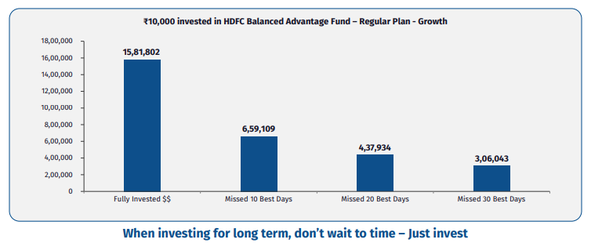
From the above content, it will be quite clear to you that time in, not timing can be a long term success so I will suggest you to invest in mutual funds through Systematic Investment Plan.

I have already recommended itself that the best time to invest was 20 years ago, the next best time to invest is now. You can directly open an SIP online and start within 5 minutes, to open and start investing now – https://investor-web.hdfcfund.com/RT/13072024050647

What is NAV in mutual funds?

Net asset value(NAV) is the value of a fund’s asset less the value of its liabilities such as operating expenses, marketing expenses, management fees, among other permissible expenses and charges per unit. NAV = (Value of Assets-Value of Liabilities)/number of units outstanding.

Let us assume I run a company. I have a factory, land property across the country, 100 Four Wheeler vehicle, 25 heavy pieces of machinery and I have borrowed a loan of Rs. 100/- from a bank. The company has 100 shares outstanding in the market.

The value of a factory is Rs. 1000/-, the value of a land property is Rs. 200/-, the value of 100 four wheeler vehicle is Rs. 100/- and the value of 25 heavy pieces of machinery is Rs. 500/-.

So my company’s total asset is = 1000 + 200 + 100 + 500 = Rs.1800/-

Since I have borrowed Rs. 100/- from the bank this is my liability which is to be repaid whether in the long term or short term.

So the company NAV is = 1800-100/100 = 1700/100 = 17

How to calculate the Fund NAV: The Mutual Fund invests the money in many different sectors and a bunch of companies to minimize the risk and diversify the portfolio.

Let us assume one large cap fund invests the money in 5 companies. So the companies NAV is different. To calculate the fund NAV you have to sum the respective company NAV and just average. Then you get the respective fund NAV. The companies in which the money is invested are Maruti Suzuki (NAV 400), Titan Company (NAV 300), State Bank of India (NAV 500), HPCL (NAV 500), and Interglobe Aviation ( NAV 300).

So, the Fund NAV is = ( 400 + 300 + 500 + 500 + 300 )/ 5 = 400.

What are open Ended and close ended Mutual funds?

A mutual fund is a professionally-managed trust that pools the savings of many investors and invests them in securities like stocks, bonds, short-term money market instruments and commodities such as precious metals.

Mutual funds are classified in a variety of ways. But the first classification is:

Open-ended funds: These funds buy and sell units on a continuous basis and, hence, allow investors to enter and exit as per their convenience. The units can be purchased and sold even after the initial offering (NFO) period (in case of new funds). The units are bought and sold at the net asset value (NAV) declared by the fund.

The number of outstanding units goes up or down every time the fund house sells or repurchases the existing units. This is the reason that the unit capital of an open-ended mutual fund keeps varying. The fund expands in size when the fund house sells more units than it repurchases as more money is flowing in.

Closed-ended funds: The unit capital of closed ended funds is fixed and they sell a specific number of units. Unlike in open-ended funds, investors cannot buy the units of a closed-ended fund after its NFO period is over. This means that new investors cannot enter, nor can existing investors exit till the term of the scheme ends. However, to provide a platform for investors to exit before the term, the fund houses list their closed-ended schemes on a stock exchange.

Trading on a stock exchange enables investors to buy and sell units through a broker in the same manner as transacting the shares of a company. The number of outstanding units of a closed-ended fund does not change as a result of trading on the stock exchange. The closed-ended funds are free from the worry of regular and sudden redemption and their fund managers are not worried about the fund size